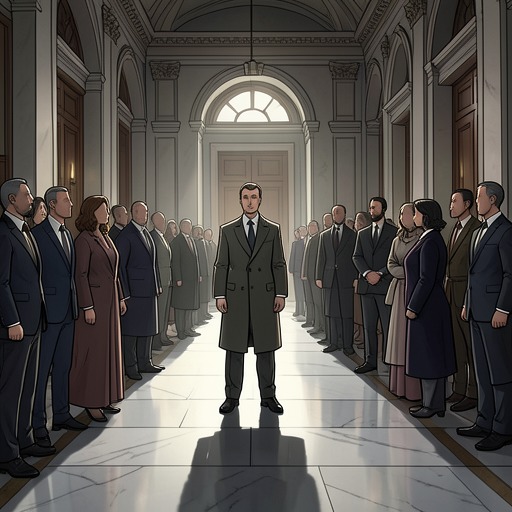
Professor Caldwell
Martin EdenProfessor Caldwell is a young English professor whom Martin Eden encounters at a gathering in the Morse home. Their conversation becomes a pointed exchange about the limits of intellectual judgment: Martin argues that Caldwell’s learning lacks an interpretative grounding in biology, and Caldwell admits that the criticism has substance. The encounter unsettles Ruth’s reverence for her former teacher and gives Martin a new measure of both his own knowledge and the possibilities he believes Caldwell has left unexplored.
Identity and Place in the Gathering
Caldwell appears among the educated company at the Morse home as a figure of established intellectual standing. Ruth has attended two of his lecture courses and has known him for two years; she regards him as a living repository of knowledge. To Martin, who has rarely encountered people of this social and educational world in such numbers, Caldwell is at first an especially compelling presence. Martin notices his trained mind and command of knowledge, and wants to hear him discuss his professional subject rather than remain within the usual bounds of polite conversation.
That wish reflects Martin’s own belief that social gatherings should allow people to exchange what they know best. He considers specialized work and knowledge more revealing than conventional polite talk. Caldwell seems initially reluctant to talk shop, but Martin draws him into it. The professor’s response matters to Martin not simply as a display of learning: it offers a way to test what he has gained through his independent reading against the expertise of someone formally educated.
The Conversation and Martin’s Challenge
As Caldwell speaks, Martin follows the argument closely and critically. He recognizes that the professor’s knowledge covers a broad field, but the discussion also makes visible subjects Martin himself has not yet studied. His reading of Herbert Spencer has, in his view, supplied an outline of knowledge that he can eventually fill in. He listens with admiration, yet notices what he considers a weakness in Caldwell’s judgments. That perception abruptly changes the balance between them: Martin moves from feeling like a student at the professor’s feet to believing he can meet him as an intellectual equal.
Martin locates the weakness in Caldwell’s lack of biology. He means not merely a narrow technical subject, but interpretative biology extending from laboratory work to broad aesthetic and sociological generalizations. He argues that biology is fundamental to understanding human action and achievement, and that excluding it leaves a gap in Caldwell’s way of interpreting the world. Martin also acknowledges that his formulation is not fully prepared: the idea has taken shape while Caldwell is speaking, and he has not yet found a fully coherent way to express it.
Ruth approaches while the discussion is under way and is appalled by Martin’s intervention. Because she looks up to Caldwell, she hears the challenge as an affront to a figure whose knowledge she trusts. Caldwell, by contrast, does not dismiss Martin. After sitting silently and fingering his watch chain, he says that the same criticism had once been made by the scientist and evolutionist Joseph Le Conte. He then concedes that Martin’s argument has considerable force, while reserving uncertainty about its full extent.
Caldwell’s Admission and Its Limits
Caldwell describes himself as too classical and insufficiently up to date in the interpretative branches of science. He attributes this shortcoming partly to the disadvantages of his education and partly to a temperamental reluctance to undertake the work required to remedy it. He further admits that he has never entered a physics or chemistry laboratory. His response makes the encounter more than a contest in which Martin simply defeats an authority: Caldwell recognizes a genuine limitation in his own training, but does not claim that Martin has conclusively settled the question.
This admission complicates the image of Caldwell as the all-knowing teacher Ruth has imagined. His formal command of knowledge is real, yet he acknowledges boundaries in the education behind it. At the same time, his willingness to acknowledge the criticism gives Martin’s view a serious hearing. The scene thus distinguishes intellectual authority from completeness: Caldwell remains learned, but his own account reveals that his learning has been shaped by omissions he has not overcome.
Martin’s Reading of Caldwell
Afterward, Ruth draws Martin away on the pretext that he has monopolized Caldwell and that others may want to speak with him. She asks for Martin’s first impression of the professor, expecting his assessment to bear on her own long-held regard. Martin calls Caldwell the finest specimen of intellectual man he has met, but adds that he perceives a hidden shame—not anything vulgar or paltry, but a private awareness of something left undone.
Martin describes his impression through several related images: Caldwell as someone who has reached the bottom of things but recoiled from what he found; as someone who glimpsed a hidden destination and then persuaded himself it was an illusion; and as someone who might have accomplished more but discounted accomplishment while secretly longing for both its rewards and the joy of doing. These are Martin’s interpretations, not facts Caldwell confesses. Ruth says she does not read him that way and does not understand what Martin means. The difference exposes a limit in their exchange: Martin believes he can discern an unspoken conflict in the professor, while Ruth’s experience of Caldwell has not led her to the same conclusion.
Narrative Role
Caldwell’s importance in this episode lies in the double reversal his presence produces. Martin enters the conversation conscious of the gap between himself and a university professor, yet his independent study enables him to identify a weakness the professor himself recognizes. Caldwell, in turn, is neither the infallible authority Ruth supposes nor merely the failed figure Martin imagines. His candid admission supports Martin’s critique of his education, but it does not establish Martin’s broader theory about Caldwell’s private regrets.
The episode therefore makes intellectual encounter a measure of both knowledge and interpretation. Martin can challenge a professor because he has formed a framework of his own; he can also overreach when he turns a brief exchange into a reading of another person’s inward life. Caldwell’s reply grants the biological argument weight without confirming that psychological reading. For Ruth, the same conversation is a shock to her respect for an authority; for Martin, it is evidence that intellectual equality may emerge through attentive criticism, even when the critic has not yet filled all the gaps in his own education.